
|

|

|
|

|
|



6. Diabetes Risk Starts Lower Than Previously Thought in Asian Indians
Rethinking “Normal” BMI
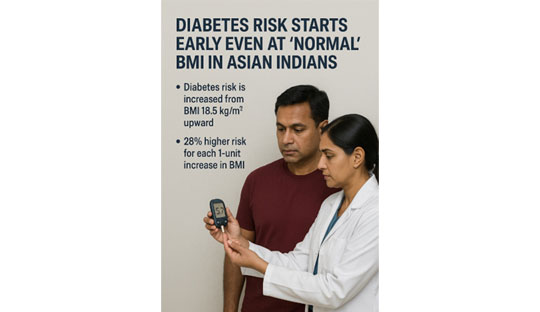
For decades, Body Mass Index (BMI) thresholds have guided diabetes risk assessment. In Asian Indians, a BMI of above 23 kg/m² is commonly used to define overweight, signaling increased risk for type 2 diabetes (T2D). However, new findings from the India Heart Watch (IHW) study challenge this assumption, showing that the risk of developing T2D begins at a BMI as low as 18.5 kg/m² traditionally considered the lower bound of “normal weight.”
Study Design and Key Findings
The study analyzed urban adults across multiple medium-sized cities in India as part of the IHW project, which assessed cardiovascular and metabolic risk factors in representative populations. Using the Mantel-Haenszel test to examine the relationship between BMI and T2D, researchers found a clear, linear association: for every 1-unit increase in BMI, the odds of developing T2D increased by 28% (Odds Ratio = 1.28, 95% Confidence Interval [1.19–1.37], p < 0.0001). Notably, the elevated risk begins right from BMI 18.5, far below conventional overweight thresholds.
Implications for Care and Prevention
This finding carries important implications. A “normal” BMI does not guarantee protection against T2D, particularly in urban Asian Indians who may develop insulin resistance and central adiposity at lower BMI than Western populations. Early lifestyle interventions including a balanced diet, regular physical activity, and routine glucose monitoring can be crucial even for those within the normal BMI range. Clinicians may also need to adopt more individualized risk assessments, considering BMI alongside other factors such as family history, physical activity, and metabolic markers.
From a public health perspective, these findings suggest that screening and preventive strategies may need to lower BMI thresholds for risk assessment. Small increments in BMI, even within the normal range, carry substantial risk; for instance, an increase from 18.5 to 22–23 kg/m² can markedly elevate diabetes risk. Awareness campaigns are also essential, as many adults may underestimate their risk due to a “healthy” weight, delaying preventive action.
GEMS Takeaway
- Diabetes risk starts early: Risk is measurable from BMI 18.5, not just at overweight or obesity thresholds.
- Small BMI changes matter: Each 1-unit increase raises T2D risk by 28%.
- Lifestyle is key: Regular exercise, healthy eating, and weight maintenance are critical, even for those in the normal BMI range.
- Early screening matters: Fasting glucose and HbA1c monitoring can detect prediabetes before complications occur.
- Policy Implication: Lower BMI cutoffs may be warranted for Asian Indians to guide preventive strategies effectively.
For enquiries info@jothydev.net.
Please visit: jothydev.net | research.jothydev.com | diabscreenkerala.net | jothydev.com/newsletter