
|

|

|
|

|
|



6. Heat-Stable Malaria Vaccine Shows Promise for Long-Lasting Global Protection
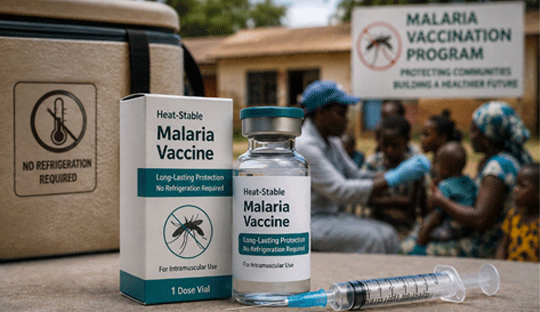
Researchers have developed an innovative malaria vaccine that could significantly improve disease prevention in some of the world’s most vulnerable regions. Unlike many current vaccines that require continuous refrigeration, this new vaccine remains stable at higher temperatures while still generating strong and durable immune protection. The breakthrough could greatly simplify vaccine transport and storage in remote and low-resource settings, particularly across parts of Africa and Asia where malaria continues to cause substantial illness and mortality. Scientists believe this advancement may help strengthen vaccination campaigns by reducing dependence on complex cold-chain systems and improving accessibility in underserved communities. The vaccine works by using tiny, safe particles engineered from bacteria that act like a scaffold displaying important malaria proteins to the immune system, effectively training the body to recognize and destroy the parasite.
A particularly promising feature of the vaccine is its dual-target strategy. It attacks two critical stages of malaria at once before infection and during transmission by preventing the parasite from reaching and infecting the liver while also blocking parasite development inside mosquitoes, thereby reducing spread to others. This multi-level protection gives the immune system more opportunities to stop malaria and reduces the likelihood of transmission between humans and mosquitoes. Preclinical findings showed up to an 80% reduction in liver-stage infection, complete protection against malaria in one in four subjects, and nearly two-thirds reduction in mosquito transmission. The vaccine also generated antibody levels well above protective thresholds and maintained immunity for at least six months, exceeding the durability of many current malaria vaccine candidates. Experts believe that improving vaccine stability, accessibility, and long-term protection could become a major step toward more equitable global vaccination efforts and stronger malaria elimination strategies worldwide. However, it is important to note that the vaccine has not yet been approved for human use, and further clinical studies are required to confirm its safety, efficacy, and long-term effectiveness in people.
For enquiries info@jothydev.net.
Please visit: jothydev.net | research.jothydev.com | diabscreenkerala.net | jothydev.com/newsletter